

Are you looking for the best whole-house fans to buy? Today, we feature the three types of whole-house fans, explain their pros and cons, and help you choose the best-rated whole-house fan for your home.
Fun Fact: Exhaust fans for an entire house can cool homes using up to 90% less energy than central air conditioning, offering significant savings. Additionally, a quiet, whole-house fan is far cheaper to install than a new A/C unit.
This is definitely a home improvement worth considering.
To operate a whole-house fan, you schedule (a wall timer) or turn it on manually at a time in the evening when the temperature outside is lower than inside your home.
You must first ensure all your windows are open and turn on the fan, which removes the heated air and replaces it with cool outside air. Whole-house fans can be controlled by a manual switch or by an automatic timer.
Video: How Does a Whole-House Exhaust Fan Work?
Benefits of Using A Whole House Fan:
Whole-house exhaust fans have been used in homes for over 100 years because they are affordable and effective at cooling interior spaces. They pull cooler(evening) air in through open windows and doors and push the warm air into the attic.
Difference between a Whole-House and Attic Fans:
Whole-house fans, sometimes called ” Attic Fans,” cool the attic by exhausting heat and removing it from the rest of the home.
Note: Whole-house fans should be used only when outdoor temperatures are cooler than indoor temperatures.
Warm attic air is exhausted upward from the home into the attic, then dispersed outside through the roof vents, where it is cooled by a house fan. Overall, this is the cheapest way to cool any home.
Replacing the “Attic Fan,” the modern whole-house fan is gaining popularity as an effective tool for cooling homes thanks to its many innovations.
Additionally, if you choose the correct size whole-home fan and live in a moderate and relatively dry climate, you can avoid using an air conditioning system entirely.
Whole House Fan – “The Pros”
- Uses far less (up to 90%) Energy than central air conditioning systems (using a condenser and blower)
- It works best in dry climates with 20 degrees (or more) of day-to-night temperature swings.
- (In-Line) Whole-house fans are much quieter because they are mounted in the attic (not the ceiling) and ducted to shutters mounted in the ceiling.
- An Insulated Whole House fan includes self-closing insulated ceiling louvers.
Whole House Fan – “The Cons“
- Whole House Fans do not Dehumidify the interior spaces of your house.
- Not suitable for very humid regions
- Draws allergens into the home
- Cools home only when the outside temperature is more relaxed than the inside house temperature
- Windows and Screen doors must be left open before turning on the exhaust fan.
- A homeowner can install whole-house fans, but a professional HVAC contractor is recommended.
*Caution: Before using a whole-house fan, you must OPEN your windows and doors. If you don’t, a whole-house fan will draw dangerous fumes from gas appliances, such as the furnace or water heater, and backdraft them into the living space, releasing dangerous carbon monoxide and exhaust fumes.
Also, check with your local building authority to make sure whole-house fans are permitted in your jurisdiction.
How To Choose a Whole House Fan:
Choosing the suitable model for your house can be intimidating if you’ve never installed a fan that evacuates all the air from your living space. You also don’t want to install a small, ineffective fan.
Using the whole-house fan sizing formula below simplifies choosing the right size for your home.
Step one: Determine how much CFM you need for your home:
To determine the correct size whole-house fan for your house, we first need to determine the CFM (cubic feet per minute) required to cool your house effectively.
The formula recommended by the Department of Energy, PG&E, and the California Energy Commission states you should move your air volume 3-6 times per hour.
Whole House Fan Sizing Method: Determine your “CFM” rating
Use a multiplier of 2 to 3 times your house’s square footage. Example: 2,000 square foot home x multiplier of 2 = 4,000 CFM.
If your house is 2,000 square feet with standard 8’0″ ceilings, consider a whole-house fan with a CFM of 4,000. The range, however, can be between 4,000 and 6,000 CFM*
The Department of Energy believes the above CFM method is the ideal CFM ratio for circulating air 3-6 times an hour, which may be excessive for most homeowners’ needs.
*Note: If you have higher ceilings than 8′-0″, multiple floors, or wish to cycle the indoor air quicker, order the next-size-up or two-size-up CFM whole-house fans.
For higher ceilings, you would order a 5,000- or 6,000-CFM-rated fan in our sample above.
Note: After you determine your CFM rate, use that rate to decide on the best type of whole house fan for your needs (See Three Types of Whole House Fans – Below)
How Is the Air Exchange (CFM) Rate Determined?
Not to get too far “into the weeds,” but some people like to know how the CFM rate is actually (scientifically) determined, and for those (nerds), here is a detailed chart on how CFM is determined:

*NOTE: Most HVAC (heating, venting, and air conditioning) contractors simplify the method using the 2 – 3 multiplier formula, which we show you in our Whole House Fan sizing Method above.
Best Type of Whole House Fans to Buy:
Are Whole House Fans Worth It?
We think whole-house fans are worth the cost of installation in any home, as long as the correct type is installed to match the home’s size and the region’s climate.
Additionally, if you prefer the movement of fresh outdoor air circulating through your home and the cost savings of running lighter, less energy-intensive air conditioners, a whole-house fan would be a worthy consideration.
These are the 3 Different Types of Whole-House Fans:
- Standard Fan – Least Expensive, Loudest, Non-Insulated
- Insulated Fan – Mid Range Cost – Insulated Dampers
- In-Line Fan – Most Expensive, Easiest installation, Includes Insulated Dampers
Choosing the right whole-house fan system depends on your goals. Is your top priority simply replacing the hot air in your home as quickly as possible?
Are you concerned about heat loss through whole-house fan louvers in winter, or is the noise level of a whole-house fan an issue when sleeping? Let’s review each “type” of whole-house fan below:
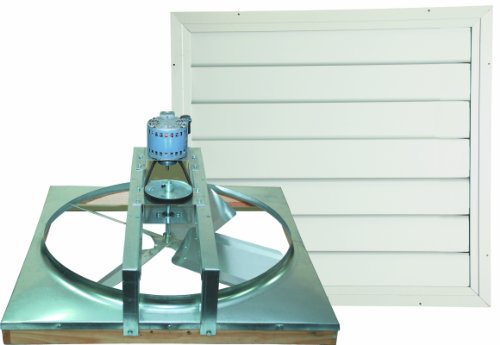
Type 1: “Standard” Whole-House Exhaust Fan
If you’re considering an exhaust fan for your house, the standard whole-house fan is the least expensive and most powerful option.
Standard exhaust fans are large (up to 30″) and can produce 4,000 – 6,000 cubic feet of air exchange per minute.
However, due to the vast amount of CFM they deliver, they may require additional joist framing in your attic and extra attic vents.
In addition, because of their design, the Standard whole-house fan is a ceiling-mounted whole-house ventilation fan. Because the fan and motor are mounted directly to the ceiling, they are much noisier.
VIDEO: How To Install Cool Attic Fan (Standard Whole House Fan)
In addition, the louvers are non-insulated – almost like an open window in the winter, producing more significant heat loss for your home. The louvers, however, can be insulated by adding a modified insulated cover for the winter season.
You can check the current cost of the Quiet Cool whole-house fan via the link below.
Editor’s Choice “Standard”: “Cool Attic” 30″ 2-Speed Whole House Fan
Type 2: “Insulated Door” Whole-House Exhaust Fan
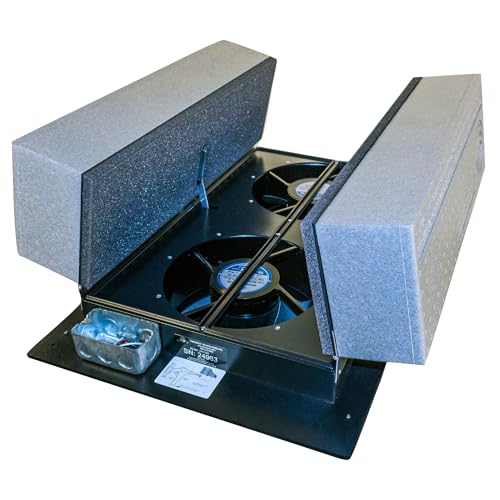
To combat the winter heat loss from a Standard whole-house fan, you might consider an Insulated fan like the Tamarack. This fan automatically keeps heating bills lower in winter while delivering lower CFM.
These whole-house fans have insulated louvers (R38) and an operation that opens and closes them each time the fan is turned on or off.
This whole-house fan prevents heat from escaping in the winter and entering the home through the attic in summer.
VIDEO: “Insulated” Whole House Ceiling Fan:
However, insulated whole-house fans, limited to 1,000 – 1,800 CFM, will take 3-4 times longer to cycle the air volume of your interior than a standard whole-house fan.
If you live in a climate with large temperature fluctuations between summer and winter, the insulated fan model can keep you comfortable without worrying about heat loss or gain from a standard fan.
Editor’s Choice “Insulated”: “Tamarack” – HV1000 R-38 Insulated Fan
Type 3: “In-Line” Whole-House Exhaust Fan
We recommend the ” in-line ” fan as the last type of whole-house fan (and our first choice). By design, it is the home’s most effective and centrally located fan.
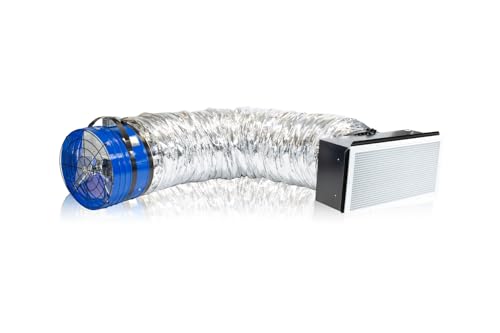
Models such as the Quiet Cool Smart Gable-mounted fan are, in our opinion, the most modern, efficient, and quiet in-line whole-house fan you can buy for your home.
The main difference between an Inline fan and a ceiling fan is that an inline fan is mounted to a truss in the attic without boxing or cutting ceiling joists.
The fan is then vented with a flexible duct down to a ceiling-mounted insulated damper. This makes the whole-house fan installation more manageable and the operation very quiet.
In-line fans come in various sizes and move air based on the CFM required for each house size.
VIDEO: “In-Line” Whole House Fan:
These house exhaust fans are pricier than standard or insulated whole-house fans. However, In-Line house fans offer a smaller damper that is less intrusive to look at than large whole-house fans and much easier to install.
To order or check the pricing and details on an In-line fan with 5,500 CFM, Timer, and Insulated Dampers, check out our first choice from Quiet Cool below:
Editor’s Choice “Best Inline”: Quiet Cool Fan “In-Line” Whole House Fan – 4505 CFM
How to Install a Whole House Fan
As mentioned earlier, you may want to consider getting an estimate for a professional to install your House fan. If that’s you, we would highly consider getting 2-3 estimates from licensed and “Experienced” whole-house fan installers in your area.
On the other hand, installing a fan of this type is very straightforward for capable DIY homeowners. Since each fan type has very different installation methods, we recommend carefully following the instructions for the type you select.
Suggestion: Look at the short video below before installing the fan yourself.
After watching the installation video, decide whether you are comfortable installing it yourself or whether it would be best to hire a professional:
Remember, the installation involves using power tools, ladders, and possibly new electrical wiring or attic framing.
How to Install Quiet Cool Gable Fan (In-Line Fan Installation) Video:
Frequently Asked Questions (FAQ)
Q: What are the Best Tips for using a whole-house fan?
A: Here are the Top 3 Safety Tips to consider before using a Whole House Fan:
- Consider installing window stops on all windows you intend to open to prevent anyone from entering the house through them.
- Window stops are mounted on the window jambs and prevent the window from being raised beyond the limited height needed to operate the whole-house fan. Window stops can be set at a 6 – 8″ maximum opening to prevent unwanted entry.
- Always open windows and, if necessary, screen doors to let fresh air into the home before turning on the whole-house fan.
- Open windows are critical for preventing backdrafting of gas-burning appliance fumes into the home, introducing fresh air into the home, and protecting the whole-house fan motor from overwork and motor burnout.
Q: When is the Best Time to run a whole-house fan?
A: The best time to run a whole-house fan is in the evening after the outdoor temperature has fallen below 75 degrees Fahrenheit. This cooler air will replace the warm, humid air with cooler, drier air from outside.
Q: How Long Should You Run a Whole House Fan?
A: You should run a whole-house fan in the early evening after the outdoor temperature falls below 75 degrees. Ideally, keep the fan running for no more than 2-3 hours, or until the inside temperature is suitable for sleeping.
Newer whole-house fans include a wall switch with a timer or thermostat, which you can set and adjust to suit your needs.
Q: How Many Windows Should Be Open To Run a whole-house fan?
A: Open at least 2-3 windows before turning on a whole-house fan. Ideally, opening windows far from the fan helps quickly evacuate the warm interior air.
Conclusion
Whole-house ceiling fans are an extremely efficient and affordable way to disperse interior home heat to the outdoors.
While cooling off your home, they can also be used with or without an air conditioning system. Some owners choose to run the A/C during the day and the whole house fan in the evening.
Others prefer fresh air over the stale recirculated air produced by A/C systems and use the whole-house fan exclusively.
Our advice: A House fan may be the perfect cooling source if you prefer fresh air and like saving money on your electric bills.
For the most peaceful (quietest) sleep, insulated efficiency, timer control options, a 4500 CFM-rated quiet whole-house fan, and generally easy installation, Our First choice is the Quiet Cool Whole-House Ceiling Fan model QC—CL-4700.
Thanks for visiting Besthomegear.com – and don’t miss our other How-To-Guides for Homeowners.
Additional Reading & Resources for Homeowners
- How to Remove Hard Water Stains From Your Toilet
- How To Remove a Dishwasher (Before New One Arrives!) – BestHomeGear.com
- How To Replace a Lavatory Faucet
- How To Connect Rain Barrels and Save Water – Besthomegear.com
- How To Get Rid Of Ants Permanently – Besthomegear.com
- How do you clean and change your Lawn Mower spark plug? – BestHomeGear.com