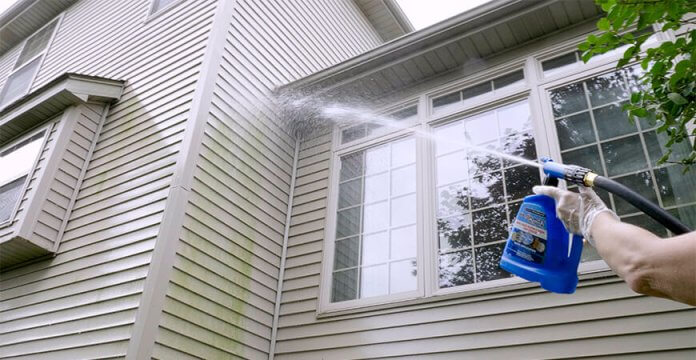

If you’re looking for the Best Vinyl Siding Cleaner for your home, you’re in the right place. Today, we share the results from our research and list the top-rated best vinyl siding cleaners you can buy – and, more importantly, which vinyl cleaners work best!
We’ve all seen the dreaded “green monster” of mold or mildew on the neighbor’s siding – or, heaven forbid – your vinyl siding :)
Each of the Vinyl siding cleaners in our Buying Guide works well. However, each product application may differ slightly.
These “cleaners for vinyl siding” make removing mold, mildew, and dirt easy, and with most of the cleaners we feature below, you don’t need a pressure washer.
“RMR-86″ Vinyl siding cleaner is premixed and ready to go, whereas a product like “Wet & Forget” requires mixing 5 parts water with 1 part concentrate.
If you’re seeing any of the above vinyl-stain conditions, your house has probably gone too long between baths. This is the “Before & After”– following the application of vinyl siding cleaner.

Years ago, the only solution for cleaning vinyl siding was to rent or own a Pressure Washer or scrub it with a soft brush and a garden hose to remove mold.
Today, however, there is a much quicker, easier, and less expensive way to clean vinyl siding effectively.
This year, get your hands on one of the best siding cleaners listed below. These products are specially formulated to guard against existing and future mold, and you will be amazed at how easy they are to use.
8 Best Vinyl Siding Cleaners in 2026
RMR-86 Instant Mold and Mildew Stain Remover

The RMR-86 Mold Removal product is advertised as a miracle cleaner, and we think it lives up to that claim. RMR-86 cleans stubborn mold and mildew in 15 seconds or less—and does so almost effortlessly.
You don’t need to scrub or brush; you fill a bug sprayer, spray the stained area, wait for 15 seconds, and watch the transformation begin. I have used this product repeatedly and “always” with great success.
The RMR-86 product linked here is for a 2-gallon container (128 ounces) and is applied full strength (not concentrate). Per the manufacturer, this amount of mold killer will cover 500 sq. ft of material.
Another thing we love about RMR-86 is its versatility. It can be used on any surface, including wood, vinyl, concrete, fiberglass, and siding.
Interestingly, it can penetrate porous surfaces quite well without changing their color. It’s genuinely one of the best Vinyl siding cleaners on the market.
RMR-86 Vinyl Siding Cleaner Video: Watch how fast this Works!
Application Method
- Garden/Pump Sprayer – pre-mixed vinyl siding cleaner solution
- No Manual Scrubbing
- Fast Action
- Works On Different Surfaces
- More Expensive Than Other Brands
- Bleach Can Damage Plants
- One Gallon To Treat 250 Sq. Feet
RMR-86 – Editor’s Pick – Best Vinyl Siding Cleaner
RMR-86
Wet and Forget 10587 Mold & Mildew Remover
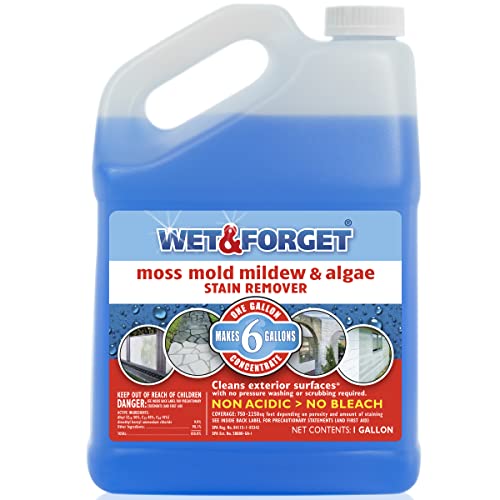
If you don’t feel comfortable using a bleach-based cleaner, we’ve got you covered. Wet & Forget is non-acidic and non-caustic, so you can use it safely on any surface without worrying about harming animals or plants.
The manufacturer, however, cautions users to rinse all plants before and after the application. Otherwise, you may see temporary leaf browning or leaf death.
The Wet & Forget aim is to make your life easier and your cleaning smarter with a user-friendly “spray and walk away” product. Rain will eventually remove any residue, and, like RMR-86, there is no need for abrasive scrubbing.
Of course, if you live in an arid climate – like the southwest – you could go weeks without rain, so Wet & Forget may not be your first choice :)
To use Wet & Forget, you will need a typical garden sprayer and water to mix five parts water with 1 part Wet & Forget concentrate. Spray liberally on the material you want to remove mold and walk away. Literally.

The “trade-off” from using RMR-86 instead is that Wet and Forget is a more gradual cleaning agent, and while you should see results within a week, Wet & Forget requires 1-3 months to remove visible mold and stains entirely.
Wet & Forget is still considered one of the best vinyl siding cleaners on the market, especially if you have time to allow the product to do its job and want the simplest application method.
One precaution to keep in mind is the weather conditions. If the product hasn’t thoroughly dried, rain will rinse it before it activates. Windblown debris may also cause an unsightly outcome.
Pick a clear day to apply the cleaner, and you’re ready!
Application Method
- Garden/Pump Sprayer—For Wet and Forget: Mix five parts water with 1 part Cleaning solution, then apply to vinyl siding.
- 2,000 Sq. Feet per 5 Gallon Mixed Product
- No Scrubbing
- Safer For Plants
- Lasting Mold Removal (Stays Gone)
- It takes Up To 30 Days To Remove Mold
Wet & Forget – Mold & Mildew Siding Cleaner
Wet & Forget
Mold Armor FG503 E-Z House Wash

This is a cleaner that’s dedicated to outdoor use. You only need to spray the product, wait 10 minutes, and rinse it.
The 64-ounce bottle can clean up to 4,500 square feet, which is ample space. You can also purchase a handy spray adapter, which is included. Watch the Mold-Armor E-Z House Wash Video in Action below:
As one of the best siding cleaner formulas, it quickly removes mold and mildew stains without scrubbing. Your exterior will instantly regain its old luster, and you can dilute it to clean mild stains later as needed.
Application Method:
- Garden/Pump Sprayer – pre-mixed vinyl siding cleaner solution – Or Garden Hose attachment
We recommend applying Mold Armor as a pre-mixed solution and using a garden pump for the best results.
- Good Mold & Mildew Removal
- Won’t Fade Paint or Vinyl
- Bleach Formula – Can Harm Plants
- Requires Hose Applicator
Mold Armor – EZ House Wash Siding Cleaner
Mold Armor
Best Siding & Roof Cleaner: “Spray & Forget” Roof Cleaner

The name sums it up: Spray & Forget is one of the most user-friendly siding cleaners. While users reported the best results with vinyl siding, the manufacturer also claims it is effective on wooden and metal surfaces, especially roof shingles.
For those with environmental concerns, Spray & Forget is listed as non-corrosive. It does not contain bleach, acids, lye, phosphates, or heavy metals, making it an eco-friendly product.
The non-corrosive formula eliminates mold and algae without scrubbing or washing. Spray & Forget boasts that its product will keep your roof clean for 6-9 months after use.
Be sure to use this product on roofs that are excellent—not heated—before application.
Spray And Forget Roof Cleaner Video:
Application Method
- Mix Spray and Forget solution: 1 gal. Water to 22 oz. Parts solution and apply with the Garden Sprayer
- Environmentally Friendly
- Economic
- Non Corrosive
- Takes Time To Work
- Less Potent – Requires Re-Application
Spray & Forget – Roof and Siding Cleaner
Spray & Forget
Best “Biodegradable” Cleaner: “Simple Green” – Oxy Siding Cleaner

Simple Green is an all-purpose, biodegradable, environmentally friendly siding cleaner. It was developed for multi-purpose contractor jobs, which explains its versatility. It can be used on many surfaces, including vinyl, wood, and metal. It removes grease and molds efficiently.
Its biodegradable properties make it entirely safe for indoor and outdoor use—you won’t need to worry about your children or pets.
The fragrance-free claim is a bit misleading, however. Although the product smells clean and non-chemical, it still has a noticeable cleaning-product odor.
It is worth noting that it’s a complete product. One gallon of Simple Green for Vinyl Siding can produce about 64 mixed gallons. You should dilute it based on the surface and the stains you’re treating.
Also, Simple Green’s safer, more gentle cleaning solution does not attack mold and mildew like the more potent formulas above. Thus, it is a soft and more environmentally friendly approach to cleaning vinyl siding.

Application Method
- Mix Simple Green Solution; 64 parts water to 1 part solution 64:1
- No Respirator Required
- Biodegradable
- Versatile On Many Surfaces
- Works Best with a Pressure Washer
- Won’t Remove Stubborn Stains
Simple Green – Biodegradable Siding Cleaner
Simple Green
Best Priced Siding Cleaner: Krud Kutter HW01 Clear House Wash
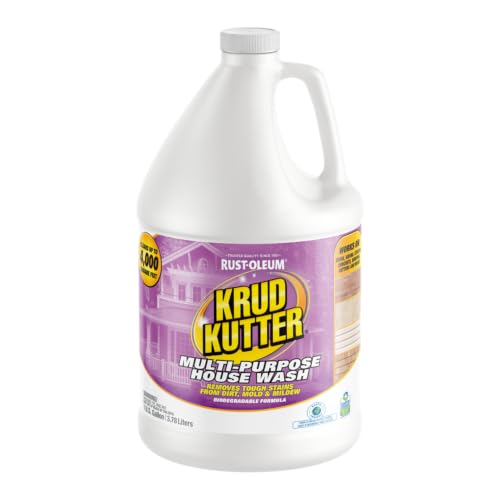
Who said you have to pay a fortune for a good cleaner? Krud Kutter House Wash destroys this myth by being a perfect cleaner for people on a tight budget. It’s a bleach-free, fast-acting siding cleaner you’ll be pleased to use.
“Sporex” is a unique additive in Krud Kutter’s proprietary formula. It is said to dissolve algae, mold, mildew, and fungus stains, making it an excellent product for washing vinyl siding.
The product is biodegradable and safe to use around vegetation if you wash it before and after use. A necessary precaution is to avoid letting the product dry on the surface. You should rinse it after 10-15 minutes.
Application Method
- Garden Sprayer – Mix 19:1 Water to the Solution and apply to vinyl siding.
- Removes Chalking, Fading on Wood, or Vinyl
- It works better with a Pressure Washer
- Add Bleach For Stubborn Stains
Krud Kutter – Best Value Siding Cleaner
Krud Kutter
Best Siding Cleaner with Sprayer Attached: “30 Seconds” Cleaner
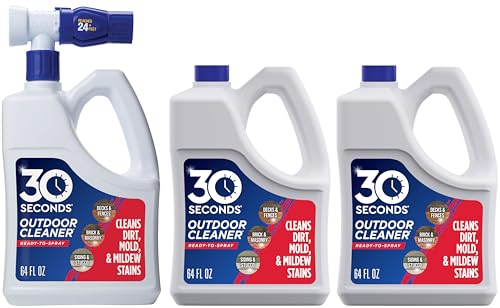
Tired of getting on a ladder to reach your roof and tricky places where mold finds a home? This version of 30 Seconds Cleaner solves the problem with its brilliant Hose End Sprayer built into the container.
You can use this product by attaching the bottle to your garden hose, adjusting the sprayer, and applying water to your siding.
You won’t need to scrub the product after spraying it. Just spray it on, wait 10-15 minutes, and then hose it off. Be careful to calculate the right amount of product based on your house’s size.
Our link below is the 3-gallon Pack, which covers up to 1200 sq. ft. of vinyl siding.
It’s better to have too much than not enough product to finish what you started.

Application Method
- Garden Hose – Applicator included
- Thoroughly saturate ALL vegetation/landscaping with water before and after use of this siding cleaner.
- Hose Attachment For Simple Application
- Needs No Scrubbing
- More Expensive Brand
- This Cleaner will Bleach Clothing (Wear Old Clothes:)
30 Seconds – Siding Cleaner with Hose Applicator
30 Seconds
“Vinyl Renu” – Vinyl Siding Restorer
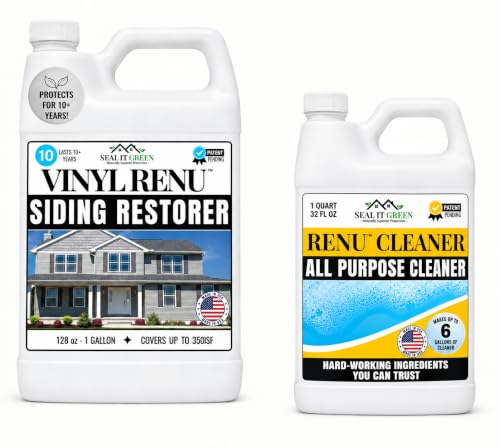
This one offers a different approach to restoring your vinyl siding. Vinyl Renu is engineered to restore vinyl siding to its original color and sheen. It does so through its eco-friendly ingredients, which penetrate the surface and reverse the effects of age.
It’s a miracle product that restores vinyl siding and also works on metal siding, stucco, Hardie board, garage doors, front doors, mailboxes, and more.
However, while this product is excellent for restoring entire material surfaces, it will not magically renew defective, pitted, or otherwise damaged surfaces.
Specs
- 1 Gallon restores up to 350 Sq. Ft.
- ECO- Friendly – No VOC – Water-Based solution
- Warranted for ten years
- Easy To Apply with Pump Sprayer
- Works on Any Siding
Vinyl Renu also manufactures its cleaning solution, Renu Cleaner, which is the only recommended pre-treatment before applying the Vinyl Renu restoring solution.
- Works on Any Vinyl Siding
- Less Expensive Than New Vinyl Siding
- Will Not Cover Mold or Mildew
Video Instructions: How To Use Renu Cleaner and Vinyl Renu Restorer
At only .34 cents per square foot vs. the national average of $4.00/square foot. For installing new vinyl siding, we think Vinyl Renu is a great solution (pardon the pun) for anyone with old, faded, or chalky vinyl siding.
Indeed, if your vinyl siding is in good condition and covered with mold or mildew, we recommend any of the seven vinyl siding cleaners we have reviewed (Above).
Vinyl Renu – Vinyl Siding Restorer
Vinyl Renu
Tips on How To Clean Vinyl Siding:
Clean Vinyl Siding Without Scrubbing:
Many homeowners have been told that the only way to clean vinyl siding is with a pressure washer, but that is no longer true.
Around twenty years ago, a few vinyl siding products that do not require scrubbing or a pressure washer came on the market.
The three best “No Scrub”/No Pressure Washer vinyl siding cleaners are RMR-86, Wet and Forget, and 30 Seconds Outdoor Cleaner. All three are featured in our reviews (Above).
I have used all three siding cleaners in Michigan, Arizona, and Florida (Florida is by far the worst for Mold), and they all work great!
I lean towards Wet and Forget, which is mixed with water and applied to vinyl siding with a garden sprayer.
Then, you sit back and watch mold and stains disappear over 30 days—no pressure washer and no dragging hoses to spray off the siding!
However, if you need to remove mold and stains from the vinyl siding more quickly, RMR-86 removes them almost immediately.
You must take more precautions to protect your plants, garden, and lawn, as RMR-86 is the most toxic to green life.
Is using a “Pressure Washer” to Clean Vinyl Siding Safe?
Whether or not it’s okay to use a pressure washer to clean vinyl siding depends on several factors:
- Low pressure is generally considered safe for vinyl siding. Aim for a pressure setting of around 1,500 psi or less.
- High pressure can damage siding, causing cracks and warping, and can even allow water to seep behind it, potentially leading to mold and mildew growth.
Nozzle:
- Use a wide fan nozzle to disperse the pressure and avoid concentrating it in one spot.
- Avoid using a turbo nozzle, which can be too powerful for vinyl siding.
Distance:
- Hold the pressure washer nozzle at least 18 inches away from the siding. This will help prevent damage and ensure even cleaning.
Cleaning solution:
- Use a cleaning solution specifically designed for vinyl siding. Avoid using harsh chemicals, such as bleach, which can damage the siding.
Condition of the siding:
- Newer vinyl siding is generally more resistant to pressure washing, while older siding may be more brittle and more susceptible to damage.
- NOTE: If the siding is already cracked or damaged, it’s best to replace it rather than use a pressure washer.
Additional factors:
- Temperature: Avoid pressure washing in cold weather; the vinyl siding can become brittle and crack.
- Surroundings: Avoid damaging nearby plants or landscaping with the pressure washer.
Here are some general recommendations:
- A garden hose or a soft wash method may be sufficient for routine cleaning.
- If you are using a pressure washer, use the lowest pressure setting possible and keep the nozzle at least 18 inches from the siding.
- Always test the pressure washer in an inconspicuous area first to ensure it doesn’t damage the siding.
- Consulting with a professional is always best if you are unsure about using a pressure washer.
Ultimately, the decision of whether to use a pressure washer to clean vinyl siding is up to you. However, by carefully considering the factors above and using the proper technique, you can help minimize the risk of damage to your siding.
How To Prevent Mold and Stains from Returning to Vinyl Siding:
Preventing future mold growth:
- Improve drainage: Ensure water drains away from the siding and does not pool or stagnate. Grading the soil around the house so it slopes away from the foundation and regularly cleaning gutters and downspouts can help.
- Increase air circulation: Trim trees and bushes back so they do not shade the siding and prevent it from drying out. You can also install attic vents to improve air circulation.
- Regular cleaning: Clean the vinyl siding regularly with a garden hose and a mild cleaning solution. This will help remove dirt and grime, which can be a food source for mold.
- Use a mold-resistant sealant: Once the siding is clean and dry, apply it to help prevent future mold growth.
Additional tips:
- Avoid harsh chemicals: Bleach and other harsh chemicals can damage vinyl siding and make it more susceptible to mold growth.
- Test any cleaning solutions or sealants in an inconspicuous area first.
- If you have a large mold area or are unsure how to remove it, consult a professional.
These tips can help prevent mold from returning to your vinyl siding and keep your home looking its best.
Frequently Asked Questions (FAQ)
Q: What Is The Best House Siding Cleaner?
A: In our opinion and from our experience, the best house siding cleaner is the type of siding cleaner you spray on and walk away.
Products such as Wet & Forget house and siding cleaner are among the best examples. They are concentrated concentrates ready to mix with water, applied with a pressure sprayer, or avoided entirely using a pressure washer.
For dirty siding (without mold or mildew attached), a good DIY Siding Cleaner can be made by mixing 30% vinegar with 70% water, or by mixing Dawn Dishwashing liquid with Hot water.
However, in our experience, both DIY methods work well for general cleaning but not for mold or mildew removal.
Q: Which Siding Cleaner is Safe For Plants?
A: From our research, only one vinyl siding cleaner describes its product as “Safe for plants”; that product is a simple green “biodegradable” cleaning solution (see review above).
However, as mentioned in our article, Simple Green is considered a multi-purpose cleaner, not specifically made as the ultimate vinyl siding cleaner. It isn’t, but it is supposed to be an environmentally safe product.
In the end, to be safe around plants or other vegetation, use a vinyl siding cleaner. Hose down the plants with a wide-angle nozzle from a garden hose, saturating them just before applying the house cleaner.
When you’re finished applying the siding cleaner, respray the vegetation, rinsing thoroughly, and you should be all set. This has been my approach for over 5 years, and I have had no damage to plants from vinyl siding cleaner applications.
Q: Which Vinyl Siding Cleaner Brand Should I Buy?
A: Our favorite Vinyl Siding cleaner is Wet and Forget. It is formulated to spray on the vinyl siding and walk away, and full results take 1 – 3 months to achieve.
I personally use Wet and Forge often – because it works amazingly and doesn’t allow mold to return quickly, if ever!
Other products we’ve reviewed, such as “30-Seconds Cleaner,” require hosing the siding off with water about 10-15 minutes after applying the vinyl siding cleaner.
Some products, like RMR-86, cost more due to their full-strength application and limited coverage of your house. However, they are more powerful stain and mold removers (compared to pressure washers) and work instantly (within 15 seconds).
Whatever type of siding cleaner you choose, these specially formulated mold and mildew removers do fantastic work. In a short time, your Vinyl Siding should look as good as new.
Q: How Much Vinyl Siding Cleaner Do I Need?
A: Each Brand’s Formula determines How Much Siding Cleaner You Need:
The size of your home determines the “amount” of vinyl siding cleaner you will purchase, and to determine how much vinyl siding cleaner you need, you need to estimate your square footage correctly.
Step 1: From the ground, eyeball the width and height of each side of your house.
Step 2: Next, multiply width by height and add all four sides to determine the total square footage needed. For example, 30 feet wide by 20 feet high = 600 square feet x 4 sides = 2,400 square feet of total coverage required.
Step 3: Compare the recommended coverage for the vinyl cleaning products above and choose the best vinyl siding cleaner for your needs. Some are concentrates, and some are pre-mixed; please refer to our reviews for each product’s coverage.
Q: Will Vinyl Siding Cleaner Damage Landscape?
A: If you have flowers or vegetation surrounding your house, thoroughly saturate it with water before you spray vinyl siding cleaner. You can also consider covering them to protect them during cleaning.
Most chemical cleaners are potent products that can damage your plants.
Speaking of Natural Surroundings – Check out our How-To Guide – How to build an in-ground fire pit.
Q: Can Vinyl Siding Cleaner Damage The Siding?
A: Double-check that the vinyl cleaner you purchase is safe for Vinyl products and will not bleach or damage your siding.
According to the manufacturers in our reviews, none of the vinyl siding cleaners damaged the vinyl siding.
Q: How Can I Keep Mold & Mildew Off Vinyl Siding?
A: The best way to keep mold and mildew from returning to vinyl siding is to attack the mold before it gets out of control. The best time is late spring to early summer, when you see mold starting to grow.
Your house’s location determines the type of dirt you’re likely to encounter. Very Damp areas and north-facing elevations are more likely to accumulate mold and algae on vinyl siding. At the same time, dry or windy climates may lead to a more significant buildup of dirt.
One of the most common reasons for vinyl siding stains is tree branches or large bushes within a few feet of the siding, or even touching it. Another issue is allowing grass to grow against your house’s foundation without using landscape beds.
Mowing grass against the house will allow grass spores to attach to the siding. You can count on that situation to increase the probability of mold and mildew on your house’s vinyl siding.
To prevent future staining, trim back any natural vegetation at least 4-5 feet away from your siding.
What are the Best Safety Tips For Using Vinyl Siding Cleaner?
Here are the Best Tips for Using Vinyl Siding Cleaner
- Before cleaning Vinyl Siding, spray water onto it and your surrounding foliage with a garden hose. This will help protect the vegetation from incidental contact with the Vinyl siding cleaner you will use.
- As an added precaution, you may also want to cover any high-value plants, bushes, or trees with plastic or tarps.
- After you have finished applying all Vinyl siding cleaners, remove any covering you may have used to protect the foliage, and immediately spray any foliage that may have come into contact with the vinyl cleaner with water.
- When using any vinyl siding cleaner, read the manufacturer’s instructions carefully. Make sure to wear personal protective equipment. Do not apply this harsh cleaning product to your skin.
- Wear complete protection: Use a proper respiration mask, safety goggles, rubber gloves, and a coverall jumpsuit or old clothing to cover arms, legs, and head.
How To Make Homemade Vinyl Siding Cleaner?
While the vinyl siding solutions in our review work exceptionally well, some people may prefer homemade cleaning products to chemical-based ones.
If that’s you, check out these household product recipes for making your own DIY vinyl siding cleaner:
- Mix 70% water and 30% white vinegar to make an excellent all-purpose vinyl siding cleaner. This solution removes less stubborn mold or mildew from the siding.
- To mix a more robust solution, combine 1/3 cup of powdered laundry detergent with 2/3 cup of powdered household cleaner, then add 1 quart of liquid laundry bleach and 1 gallon of water.
- If you are concerned about the surrounding vegetation, use a vinyl siding cleaner solution: mix one gallon of water with one cup of oxygen bleach in a bucket. Ensure it is labeled “Oxygen bleach” (never use Chlorine Bleach), as Oxygen Bleach will clean the vinyl without damaging your landscape.
- Also, don’t forget that one of the products in our review, “Simple Green,” is an environmentally friendly cleaner that can be used on vinyl siding, aluminum, stucco, roof tiles, and painted wood. Simple Green is non-toxic and biodegradable.
- While homemade, non-toxic cleaning solutions will work, they are less potent than chemical products for removing mold and mildew. Therefore, you may also need a pressure washer when using homemade cleaners.
Use the Best Vinyl Cleaner To Clean Vinyl Fences (To avoid stains)

Conclusion
Many homeowners have asked, “How do I clean Vinyl Siding without a Pressure Washer?” Hopefully, our article will help you see that many of the best vinyl siding cleaners clean siding “without a pressure washer.”
Using the best vinyl cleaning products, such as RMR-86 or Wet-And-Forget, you can spray on the vinyl siding cleaner (per the Manufacturer’s Instructions) and walk away. No Pressure washing is required.
We recommend cleaning your vinyl siding once or twice a year, depending on your climate.
Because of the prep work and precautions required each time you use it, make sure you choose the Best Vinyl siding cleaner you can afford.
Then spray it on, sit back, and let the product do all the work.
With all the factors in balance, our product winner is the RMR-86 cleaner for its versatility, ease of use, and fast-acting (almost immediate) results.
In second place, Wet & Forget is a safe, slower-acting, less expensive (5-gallon yield vs. 1-gallon RMR-86), but very close runner-up vinyl siding cleaner—assuming you can wait a little longer for optimum results.
NOTE: If you’re having mold problems in your house, check out our article on removing mold from wood and drywall.
Please leave us a Google Review: Your feedback helps us grow and lets other homeowners discover our site. Click Here to share your thoughts on Google!
Additional Reading & Resources
- Vinyl is Still The Right Choice for Siding – See Comparison Here – Vinylsiding.org.
- How To Clean Stained Grout – 3 Simple Steps – Besthomegear.com
- Best Garden Sprayer at Amazon to Apply Vinyl Siding Cleaners – Amazon.com
- Trim Tree Limbs Up Against Siding with a Cordless Pole Saw – Besthomegear.com
- Leaky Toilet? – Easily Replace Toilet Parts With This Diagram – Besthomegear.com
- Other resources that you may find helpful:
- How To Pressure Wash Vinyl Siding https://advantageproservices.com/
- Should You Pressure Wash Vinyl Siding? https://www.garagejournal.com/forum/threads/vinyl-siding-and-exterior-gutter-cleaning.393902/
- How to Clean Vinyl Siding https://www.youtube.com/watch?v=RlT5kqr0R-M