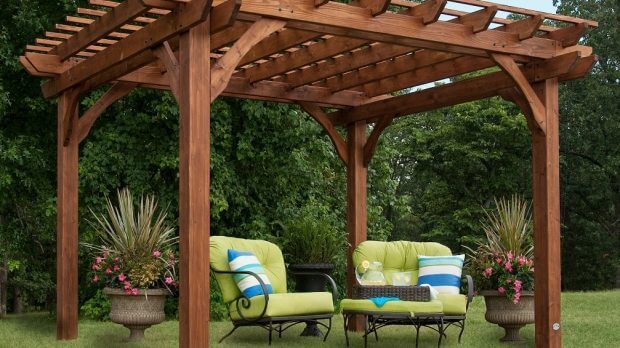

Do you want to learn How to Build a Freestanding Pergola. If so, we’re here to help you complete that project! All it takes is a clear idea of what you want to accomplish, a solid plan, and a solid list of materials.
Because let’s face it, as important as the sun is for outdoor enjoyment, sometimes we want a little less sun. Sometimes, the sun is too hot when you want to sit and read or enjoy other lazy outdoor activities.
What Is a Freestanding Wood Pergola?
A new freestanding wood pergola (see top photo) can bring life to your backyard, giving your space an Upscale or, if you prefer, Rustic feel while providing shade for a new seating area.
Along the way, you can create stone or gravel pathways to your new pergola and create the perfect destination to hang out and lounge with friends.
A pergola is a great way to provide cooling shade to your yard. The steps required to build a wood pergola are not as complicated as they may sound.
Follow our DIY guide to determine the best pergola size for your needs, the building materials you will need, and the 7 DIY installation steps to complete your pergola.
How To Build a Freestanding Wood Pergola:
1) Pick the Best Size of Pergola to Build
Pergolas can come in many sizes and shapes. Traditionally, you can find pergolas ranging from 8 to 10 feet to cover a backyard.
The seating group should determine the size you plan on setting up and, of course, the space you have to build a pergola.
Depending on the wood you choose, you should be able to build your pergola for between $500 and $750, since you are doing it yourself and reducing labor costs.
2) Best Type of Wood To Build a Pergola
Cedar is the best wood because it looks excellent and does not rot like untreated pine. Another, more common, type of lumber, due to its affordability, is treated pine.
Where treated (pressure-treated) lumber isn’t as attractive as cedar, you will save money.
One of the neat things about cedar is that, besides being naturally resistant to insects and rot, it turns a rich brownish-gray when left unfinished. Even cedar that has stayed in place for over a hundred years will have a fantastic look.
Exterior stain can also seal your wood year-round if you prefer.
Depending on the wood you choose, you should be able to build your pergola for between $500 and $750, since you are doing it yourself and reducing labor costs.
3) Buying Pergola Building Materials:
Note: 10′ x 10′ Freestanding Pergola Material List below. This is a general list of materials you will need. The following materials are required to build a typical 10′ x 10′ freestanding wood pergola:
- A – 4 pieces of 6×6 lumber – 96″ long – FOR POSTS (120″ if set in-ground)
- B – 4 pieces of 2×8 lumber – 12′ long – FOR SUPPORT BEAMS
- C – 10 pieces of 2×6 lumber – 12′ long – FOR CROSS BEAMS
- D – 12 pieces of 1×3 lumber – 12′ long – FOR OVERHEAD SLATS
- E – 8 pieces of decorative wood braces– to connect posts to support beams (See top photo)
- (1) Box 1 5/8″ galvanized deck screws
- (4) 6×6 post anchors for the concrete slab (or one bag of concrete ready-mix for in-ground posts)
- (1) Box of rafter ties (for crossbeams)
- (8) sets of 9″ carriage bolts, lock washers, nuts
- Any necessary wood filler, wood glue, and stain or paint
- Tools Needed: Skil saw, Drill, Hammer Drill (if mounting posts to concrete), 4 or 6 ft. Level, Stakes, String.
- Note: Cordless Power Tool Kits (including a cordless circular saw, drill, and hammer drill) are handy for this job, with no cords to drag around.
Material list: Courtesy of myoutdoorplans.com
If you would like to watch a step-by-step tutorial on How to Build a Pergola on YouTube, check out this video:
4) Choosing The Proper Placement for a Pergola
If you choose the wrong place for your new pergola, you won’t get the desired shade and enjoyment. For instance, if you place the pergola too close to your house, you may provide unwanted shade and darkness inside the home.
Also, look for natural features, both in the land’s topography and in nearby trees or bushes, that could enhance your pergola’s setting. Placing a pergola smack dab in the center of a large lawn may not appear very natural.
Finally, and probably most important in choosing your placement, is laying out the design and orientation to protect from the Sun.
NOTE: When installed, the rafters should run North and South, opposite the direction the sun travels, which will cast nice shade lines beneath the wood pergola. At midday, the sun will be directly overhead and less shaded.
You can learn to install vines or lattice if you require even more shade.
Remove tree limbs and bushes with a pole saw and wood chipper to quickly clear the area before building a pergola.
5) Install Pergola “Posts” (A)
When placing your pergola posts into the ground, remember a few things. First, ensure that the cedar or other wood you use has been pressure-treated so it will not rot quickly.
Four-by-four posts are perfect for staying securely in the ground.
Before placing your post locations, check out Lowe’s short video on installing temporary batter boards.
Option #1: Install Pergola Posts on a “Concrete Slab”
- Step 1: Install the pergola posts on a concrete slab to ensure maximum strength. Start by marking where you will screw the posts into the concrete slab. Step 2:
- Step 2: Next, have concrete screws handy, like Tapcon screws, which are over a ¼ inch long, and a hammer drill to pre-drill tapcon holes first to help the screws go in easier.
- Step 3: Install the (4) Post Anchors using tapcon screws to the concrete slab.
Option #2: Install Pergola Posts in the “Ground”
Some of you might not have a concrete slab for your wood pergola. If you can’t put your posts on a concrete slab, place them in the ground, below the area where frost can wreak havoc.
Before you start digging, contact your local utility company to avoid striking electric or gas lines, which could severely injure you and your project. After accurately marking your utility lines, you can dig your pergola away from imminent danger.
- Step 1: Using the batter board method, mark your post locations with small wooden stakes so you can see your layout. Measure twice, so you only have to install your posts once.
- For accurate dimensions, measurements should be taken not only parallel and perpendicular to each other, but also diagonally.
- Step 2: Dig the hole using a post-hole digger. An auger, shovel, or clamshell excavator will also suffice.
Note: The hole must be 12-18″ in diameter. You can correctly support a typical four-by-four or 6 x 6 post with a post hole at the correct width and depth.
Depending on local building codes, an 8-foot-tall structure must have holes at least 2 feet deep in the ground for stability. If you live in an area prone to high winds, you may want to make your pergola deeper, at 3 feet or more into the ground.
You can use a formula like this: .25 x (the height of the post) = the depth you should dig the hole. Example: 10 ft. post x .25 = 2.5 ft. post depth in the ground. This provides an 8-ft. (exposed) structure if posts are set in the ground.
These guidelines will help you stay in code and preserve your pergola for years.
6) Pour the Concrete For Posts
- Step 1: Now that your post is in the ground, you must place concrete around it to strengthen it. For your pergola plans, a 40-pound bag of ready-mix should be enough for this project. You must mix 6 gallons of water with the ready-mix concrete.
- Note: If you mix in too much water, your concrete will be weakened; it will take longer to dry, and your pergola could develop structural problems. If you do not use enough water, the concrete will not form properly, creating additional problems.
- So, it’s best to get the mix right by following the instructions. The mix should generally have a peanut butter-type consistency to be ready for use.
- Step 2: Pour the concrete into the hole around your post, and use a stick to push out air pockets. This will allow the concrete to settle correctly.
- Step 3: Allow the concrete to settle for at least 48 hours before proceeding with the project.
7) Install The Support Beams (B)
The support beams are the next thing you should focus on when making a pergola.
The best option for your pergola plans is 2″ x 8″ beams. You can also leave the beams as they are or use a jigsaw to cut or scallop out rounded edges for more design. See our photos, for example.
- Step 1: Pre-drill holes (for 9″ Carriage Bolts) into the Beam ends.
- Step 2: Tack a temporary nail through the beam at each end. This will keep your rays in place while installing the carriage bolts.
- Step 3: Use a level to keep your work perfectly level.
- Step 4: Install the 9″ carriage bolts that are at least 9 inches in length and secure them with lock washers and lock nuts
- Step 5: After you have one support beam, mirror another beam parallel on the other side of the pergola
8) Install The Crossbeams (C)
Depending on the size of the support beams, you typically use the next size down for the crossbeams, i.e., 2 x 6 lumber if the support beams are 2 x 8.
Step 1: Notch your crossbeams to fit seamlessly over the support beams. No matter what DIY pergola plans you have, a dado blade is one of the best options for your table saw.
If there is excess wood in the area you notched, use a jigsaw to clean the rest.
Step 2: Continue by scrolling the ends (optional) or leave the crossbeams as a straight edge.
Step 3: When ready to install the 2 x 6 crossbeams, lay the first crossbeam and secure it to the support beam with 1 5/8″ galvanized screws. Place a screw through the top of the crossbeam into the support beam below.
Step 4: Install crossbeams using an identical wood spacer at both support ends. The spacer should be the length that provides “equal crossbeam spacing” across the structure.
9) Install Braces and Trim (E)
To this point, you have almost completed your pergola plans. There are a few more things to do with your free-standing pergola plans. Braces and trim are next. Regarding braces, you must use the same wood as for the support and cross beams.
For example, use the same two-by-six lumber for your diagonal-sided braces. Cut them using a chop saw at 45 degrees. Cut eight diagonal braces between the cross and support beams around the posts.
Fasten with screws, and you will be on your way to finishing up your pergola.
When it comes to trim, cut pieces that cover the outsides of each post. Make sure the length and width are measured accurately for the best outcome. Most pergola plans will ask you to notch your trim effectively so it fits between your support beams.
10) Install Shade Slats (D)
Your pergola plans are nearly complete. To finish up, you will need to add your shade slats.
1 x 3 treated lumber is the perfect size for your shade slats. Shape the ends to make them more decorative, or leave them square.
Simply space 10 -12 shade slat lumber opposite the cross beams evenly. Secure with galvanized screws.
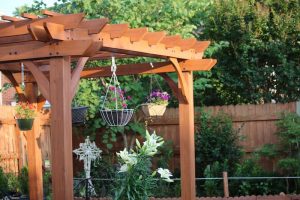
11) Install Braces and Trim (E)
To this point, you have almost completed your pergola plans. There are a few more things to do with your free-standing pergola plans. Braces and trim are following.
Regarding braces, you must use the same wood as for the support beams and cross beams.
For example, use the same two-by-six lumber for your diagonal-sided braces. Cut them using a chop saw at 45 degrees. Cut eight diagonal braces between the cross and support beams around the posts.
Lastly, fasten them with screws, and you will be on your way to finishing up your pergola.
When it comes to trim, cut pieces that cover the outsides of each post. Make sure the length and width are measured accurately for the best outcome. Most pergola plans will ask you to notch your trim effectively so it fits between your support beams.
Another step you might consider is adding a wood bench or two inside your wood pergola. This eliminates the need for removable furniture.
Also:
You may need some Privacy in your Backyard to enjoy that new Pergola. If so, check out our Article for the simplest and “Cheapest Way to Build a Wood Privacy Fence.”
Frequently Asked Questions (FAQ)
Q: How Much Does It Cost to Build a Wood Pergola?
A: A typical 10′ x 10′ Cedar or Redwood Freestanding Pergola will only average between $1500 – $2000 for materials. However, a pressure-treated lumber option may only set you back $700-$1,000 in materials.
TIP: Before you start, have your local Home Depot, Lowe’s, or Lumberyard provide the material and delivery estimate. Their price should also include delivery to your doorstep.
Q: What Type of Wood is Best For a Pergola?
A: Generally, “Cedar” and “Redwood” are considered the most attractive and best lumber for building a Pergola. Both species of wood are naturally resistant to rot and insects and have inherent beauty.
However, to save money, we recommend using pressure-treated lumber (pine). This lumber is green when new and fades to grey as it ages.
Pressure-treated lumber is an excellent cost-saving option for staining or painting your pergola after it ages.
Q: Is it Difficult to Build a Wood Pergola Yourself?
A: If you have reasonable carpentry skills and a capable friend (or more capable :) than you to help you out, there’s no reason you can’t build your DIY wood pergola. Be careful not to make it too complicated.
Many DIY pergola plans are available, which can be a bit overwhelming.
With so many pergola plans available today, deciding on one that works for you and your lifestyle can be overwhelming. This should not be a run-of-the-mill decision. Picking the right pergola design should be a well-thought-out process.
Q: Should you hire a Pro To Build A Pergola?
A: Some people are unsure they have the skills to build their Pergola. That’s quite all right—you have to know your limits.
However, hiring a pro will be considerably more expensive, as you will pay for professional labor and the contractor’s markup on the materials they supply.
If you are leaning that way, consider hiring a pro instead. They may even give you a good discount for contributing your muscle to the project. We advise pricing it both ways: DIY and hiring a pro.
Conclusion
Learning how to build a freestanding pergola is the perfect project for anyone who enjoys hanging out in the backyard but wants protection from the sun.
A pergola is not a full shelter against rain and wind but rather a shield against direct sun exposure, so it’s important to make that distinction moving forward.
No matter which pergola plans you choose, the construction must include all the major elements mentioned above. Without them, your freestanding pergola plans could end as a disappointment or be unsteady or unsafe.
Some might wonder why anyone would need a pergola. Well, it is a magnificent structure that brings your backyard to life without making your property an eyesore.
With a pergola, you can simultaneously have an indoor and outdoor space.
Once you have completed your pergola structure, you can make it your own unique hangout. For example, you could set up a wireless flat-screen TV in the summer months or add LED lighting year-round by weaving through your ceiling slats.
With a privacy fence and pergola in place, you now have your private backyard oasis!
This can liven up your pergola space for years to come. Bottom line: Have fun building your very own pergola, and start preparing today. You’ll love the space, and so will your friends!
Please leave us a Google Review. Your feedback helps us grow and lets other homeowners discover our site. Click Here to share your thoughts on Google!
Additional References & Resources
- More Tips & Tricks on How To Build a Pergola – RonHazlelton.com
- The Best Wood To Use for Pergolas – Wood-Source.Com
- 25 Outstanding “Pergola Designs” To Check Out – TheSpruce.com
- Top 7 Best Self-Propelled Mowers for 2019 – Besthomegear.com